

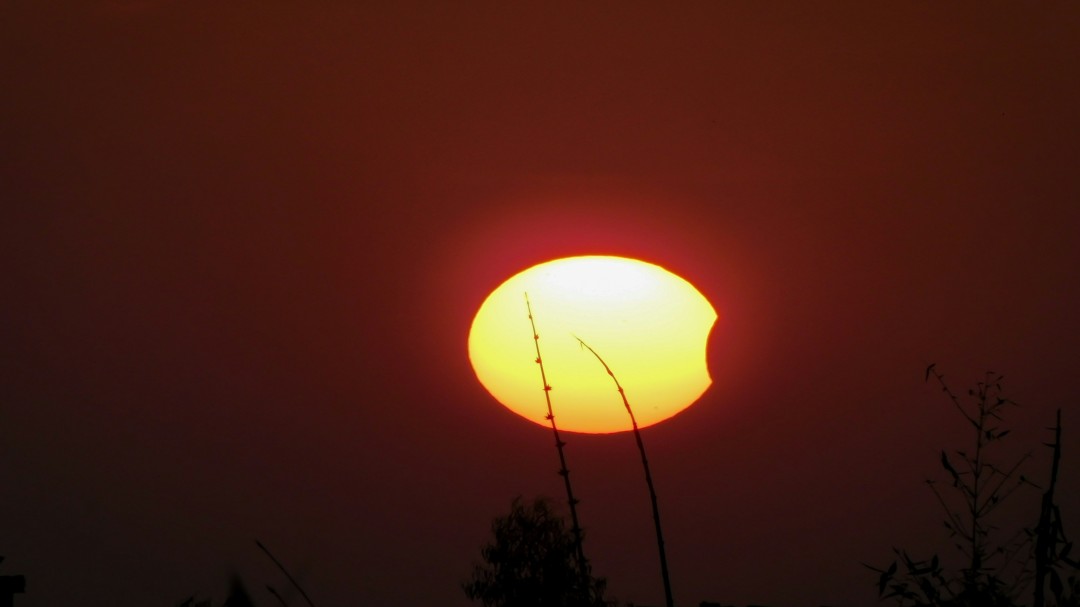

There’s something about a solar eclipse that makes the world pause. Streets grow quieter, conversations turn upward, and for a few rare minutes, the sky stages a spectacle that feels almost otherworldly. On February 17, 2026, that spectacle returns — and this time, much of India is expected to have a front-row seat.
This will be an annular solar eclipse, the kind that produces the breathtaking “Ring of Fire.” Unlike a total eclipse, where the Sun disappears completely, an annular eclipse leaves a thin, blazing circle of sunlight visible around the Moon. It happens because the Moon is slightly farther from Earth in its orbit, appearing just small enough to let that bright rim shine through.
Will it be visible in India?
Yes. Several regions across India are likely to witness the annular phase, while others will see a partial eclipse. The best views are expected from parts of western and southern India, though exact visibility will vary depending on where you are.
In cities that fall directly under the path of annularity, the Sun will briefly transform into a glowing ring suspended in the sky — a sight that photographs never quite capture the way the human eye does.
Where will the ‘Ring of Fire’ travel?
The eclipse’s path will sweep across parts of the Indian Ocean, move over sections of Southeast Asia, and continue toward Western Australia. Locations directly along this track will experience the full annular effect, while nearby areas will see a partial eclipse.
What time should you look up?
In India, the eclipse is expected to unfold during the morning hours, with the annular phase likely occurring closer to late morning or around midday. The entire event will wrap up by early afternoon. Exact timings will depend on your city, so it’s worth checking local updates as the date approaches.
A gentle reminder: watch safely
As magical as it feels, an eclipse is still the Sun — and looking at it directly without proper protection can seriously harm your eyes. Certified solar eclipse glasses or proper solar filters are essential. Ordinary sunglasses simply aren’t enough. For many families, making a simple pinhole projector at home becomes part of the experience — a small ritual that adds to the excitement.
Why this one feels special
Annular eclipses don’t happen every year over the same place. When they do, they become shared memories — the kind people recall years later: “Remember the morning the Sun turned into a ring?”
For skywatchers, photographers, and anyone who simply enjoys gazing up in wonder, February 17, 2026, promises a rare and beautiful reminder of the universe’s dynamic nature.