
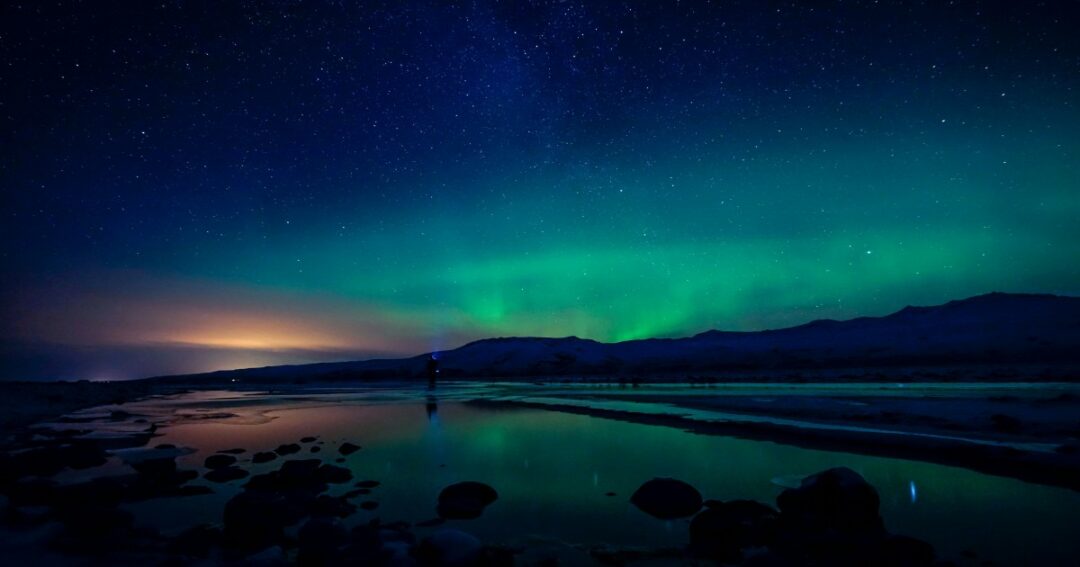

Imagine stepping outside on a cold Himalayan night and witnessing shimmering green and purple lights dancing across the sky. It sounds like a scene from Iceland or Norway, but a powerful solar storm has sparked speculation that the Northern Lights could make a rare appearance over parts of northern India.
While experts caution that visibility is uncertain, the possibility has generated excitement among travelers, photographers, and astronomy enthusiasts across the country.
What Is Causing the Aurora Alert in India?
A major solar eruption recently released a stream of charged particles toward Earth. When these particles interact with Earth’s magnetic field, they create geomagnetic storms that can produce auroras, commonly known as the Northern Lights.
The stronger the geomagnetic storm, the farther south auroras can sometimes be seen. This has raised hopes that parts of the Indian Himalayas may experience a rare auroral display.
What Are the Northern Lights (Aurora Borealis)?
The Northern Lights, scientifically known as the Aurora Borealis, are colorful displays of light that occur when charged solar particles collide with gases in Earth’s upper atmosphere.
Auroras are most commonly visible in regions near the Arctic Circle, including:
- Norway
- Iceland
- Finland
- Sweden
- Alaska (USA)
- Northern Canada
Seeing the Northern Lights from India is extremely rare, making the current possibility particularly exciting.
Best Places in India to Watch the Northern Lights
If auroral activity becomes strong enough, these locations could offer the best chances of visibility:
Ladakh
Ladakh is considered the most promising destination due to:
- High-altitude terrain
- Minimal light pollution
- Clear atmospheric conditions
- Some of India’s darkest night skies
Jammu and Kashmir
Remote areas with dark skies may provide favorable viewing conditions if cloud cover remains low.
Himachal Pradesh
Regions such as Spiti Valley and other high-altitude locations could offer opportunities for aurora sightings.
Uttarakhand
Certain Himalayan areas with clear weather and low light pollution may also have a chance of witnessing the phenomenon.
Will the Northern Lights Look the Same as They Do in Norway?
Probably not.
If visible from India, the aurora would likely appear as:
- A faint green or reddish glow
- Subtle bands of color near the horizon
- Less intense than Arctic displays
In many cases, cameras with long-exposure settings may capture the phenomenon more clearly than the human eye.
However, even a faint sighting would be a remarkable event given how uncommon auroras are at these latitudes.
Why Travelers and Photographers Are Excited
The possibility of seeing the Northern Lights without traveling to the Arctic has created significant buzz across social media and travel communities.
Photographers are preparing their equipment, while stargazers are closely monitoring space weather forecasts. For many travelers, witnessing the Aurora Borealis is a lifelong dream typically associated with expensive trips to northern Europe or North America.
The idea of experiencing such a phenomenon in India has captured widespread attention.
The Rise of Astro Tourism in India
Interest in celestial events is growing rapidly, contributing to the rise of astro tourism in India.
Travelers are increasingly seeking experiences such as:
- Stargazing in Ladakh
- Watching meteor showers
- Photographing the Milky Way
- Visiting dark-sky destinations
- Observing rare astronomical events
Destinations like Ladakh and Spiti Valley have become popular among travelers who enjoy exploring the night sky as much as natural landscapes.
Can You See the Northern Lights in India?
There is no guarantee that the Northern Lights will be visible from India. Aurora visibility depends on several factors, including:
- Solar storm intensity
- Geomagnetic activity
- Weather conditions
- Cloud cover
- Light pollution levels
Experts advise managing expectations while remaining optimistic about the possibility.
Why This Rare Event Matters
Part of the fascination surrounding the Northern Lights is their unpredictability. Unlike scheduled attractions, auroras appear on nature’s terms.
Whether the lights become visible or not, the event has encouraged people to step outside, look up, and reconnect with the wonders of the natural world.
Over the coming nights, all eyes will remain fixed on the Himalayan skies. If conditions align perfectly, India could witness one of the rarest celestial spectacles ever observed from home.